
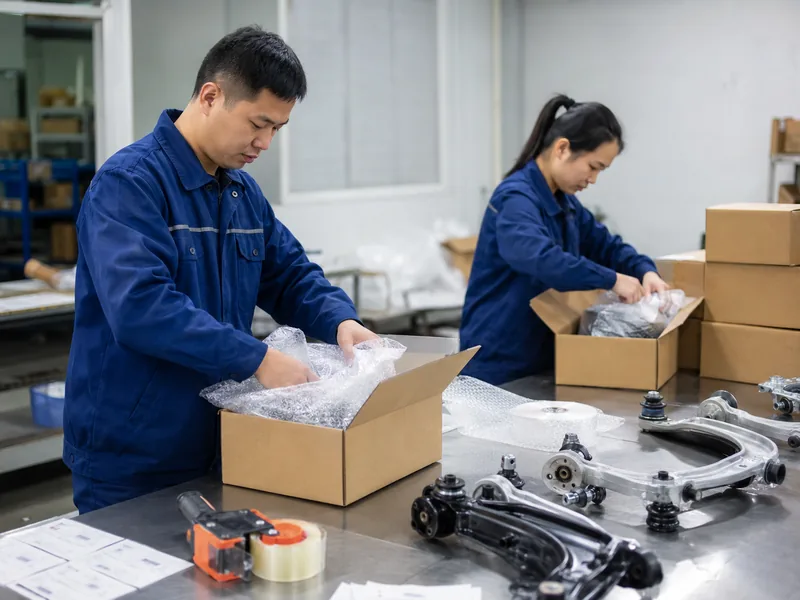
Heavy auto parts need more than a printed carton. Control arms, hubs, brake components and metal assemblies can puncture packaging, damage each other or arrive with scratched coatings after a long journey. Packaging should be agreed before the order is finalized.
Protect the vulnerable areas
Ball-joint studs, threads, sensor connections, rubber boots and machined surfaces need individual protection. Caps, foam, sleeves or shaped inserts may be necessary depending on the part.
Stop products moving inside the carton
Empty space allows a heavy part to build momentum during handling. Use dividers, molded protection or tightly arranged inner boxes. Shake-testing a sample carton is a simple way to expose weak packing.
Choose carton strength for the real load
The carton must carry its own contents and the weight of cartons stacked above it. Confirm gross weight, carton dimensions and pallet pattern. Large cartons may look efficient but become difficult to lift and easier to damage.
Make labels useful
Each carton should show the product name, OE number, quantity, gross and net weight, carton number and any customer mark. Labels should remain readable after normal warehouse handling.
Plan mixed-SKU packing
When several references share one shipment, use a packing list that identifies the exact carton for each SKU. Avoid mixing similar-looking parts in one unmarked box.
Pallet and container preparation
Cartons should be secured against sliding, protected from moisture and arranged to avoid crushing. Photograph the pallet and container loading before closing the shipment.
Custom packaging
Private-label boxes can support local branding, but buyers should first confirm design files, printing colors, minimum quantities and lead time. For early trial orders, neutral packing with clear labels may be more practical.
Packaging is a small percentage of total order value but a major factor in whether the goods arrive ready to sell. Include it in the quotation discussion rather than treating it as a final detail.