
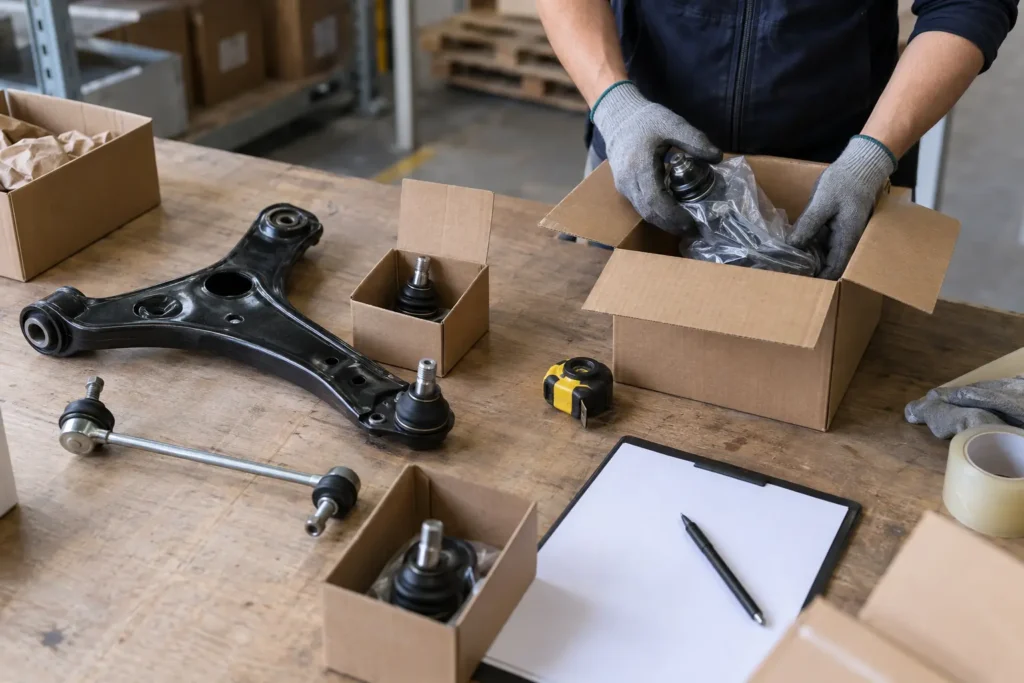
A mixed auto parts order can be profitable and still become difficult to manage. One supplier may have control arms ready today, another may need a few more days for stabilizer links, and a third may ship engine mounts in a different carton size. When those goods arrive without a clear plan, a small order can turn into a long warehouse check.
The solution is not complicated: create one master order list before goods start moving. It should connect the customer request, supplier confirmation, carton labels and final delivery address. This is useful for importers, wholesalers, workshops and trading companies that buy from more than one source.

Mixed inventories are easier to control when every line has a clear reference.
Start with one master order list
Do not manage a mixed order only through chat messages. Put the final information in one spreadsheet or shared order sheet. Each line should represent one confirmed item, not one supplier conversation.
At a minimum, include the following columns:
- Customer reference or order number
- Item number
- OE number or part number
- Product name
- Vehicle application and installation position
- Supplier name
- Confirmed quantity
- Unit price and currency
- Expected ready date
- Carton quantity, gross weight and carton dimensions
- Carton mark or label reference
- Status: pending, ready, received, checked or dispatched
This list should be frozen before final collection. Any change to part number, quantity or packing should be recorded as a new revision, rather than quietly changed in a message thread.
Give every carton a clear mark
When several suppliers deliver to one warehouse or freight forwarder, the outside of the carton needs to tell the receiver what it belongs to. A simple carton mark helps prevent cartons from being mixed with another customer’s goods.
Customer: [Customer Name]
Order No.: [JASPEEDA-YYYYMMDD-01]
Supplier: [Supplier Name]
Carton: [1 of 3]
Part No.: [OE / Part Number]
Qty: [Quantity]
For mixed cartons, add a packing list inside the carton and mark the carton as MIXED PARTS. Do not let a warehouse guess what is inside from the outside appearance of the products.
Clear item identification is also useful when several replacement parts are packed for one customer.
Check these three things before a supplier dispatches
1. Product identity
Ask for a clear photo of the actual item, label and outer carton for key or high-risk lines. Confirm that the OE number, left/right position and quantity match the master order list. A product photo is useful evidence, but it does not replace a part-number check.
2. Packing and count
Confirm pieces per inner box, boxes per carton and the total quantity. This is important when a supplier uses a standard pack quantity that does not match the order. If the order is short or over-supplied, identify it before collection rather than after export.
3. Delivery details
Send the receiving warehouse’s full address, contact person, phone number and any required warehouse code. If a freight forwarder uses an inbound number or customer code, put it on every carton mark. Confirm whether the supplier will deliver, or whether goods need to be collected.
Separate “ready” from “really ready”
Suppliers sometimes say an item is ready when production has finished, but packing, labels or delivery booking are still pending. Before you tell your customer that a shipment can move, confirm these points:
- Actual quantity is packed and counted.
- Product labels and carton marks are complete.
- Carton count, weight and dimensions are available.
- The warehouse has accepted the delivery appointment or receiving method.
- Any inspection photos or documents have been checked.
When should you consolidate, and when should you ship separately?
Consolidation makes sense when several suppliers can deliver within a similar time window and the customer benefits from one combined shipment. It may reduce handling and freight cost, but it also means the whole order can wait for the slowest line.
Separate dispatch may be better when a customer urgently needs one group of parts, when the items have very different lead times, or when a small delay would stop a repair job. The decision should be made with the customer before goods are collected, because partial delivery changes freight and receiving arrangements.
A short pre-dispatch message for suppliers
Please confirm the final packed quantity, carton count, gross weight, carton dimensions and ready date before delivery. Kindly place our order number and carton mark on the outer cartons, and send photos of the actual goods and packing list for checking.
Keep the warehouse handover simple
When the warehouse receives the goods, update the master list against the carton count and photos. Mark any shortage, damage or wrong label immediately, while the supplier can still correct it. This simple handover record gives you a clean basis for the customer packing list and final freight calculation.
For more on protecting goods in transit, see our auto parts export packaging checklist. If you are selecting stock lines for repeat orders, our guide on building a fast-moving auto parts product line is a useful next read.
JASPEEDA can help buyers organize OE references, quantities, packing requirements and delivery details before quotation and dispatch.