
Introduction
An old part photo is often the first thing a buyer sends when the original box is gone and the part number is unreadable. It can speed up an inquiry, but only if it shows useful evidence. For workshops, distributors and importers, better photos reduce back-and-forth and give the supplier a clearer starting point. They do not, however, confirm fitment on their own.
Start with the whole part
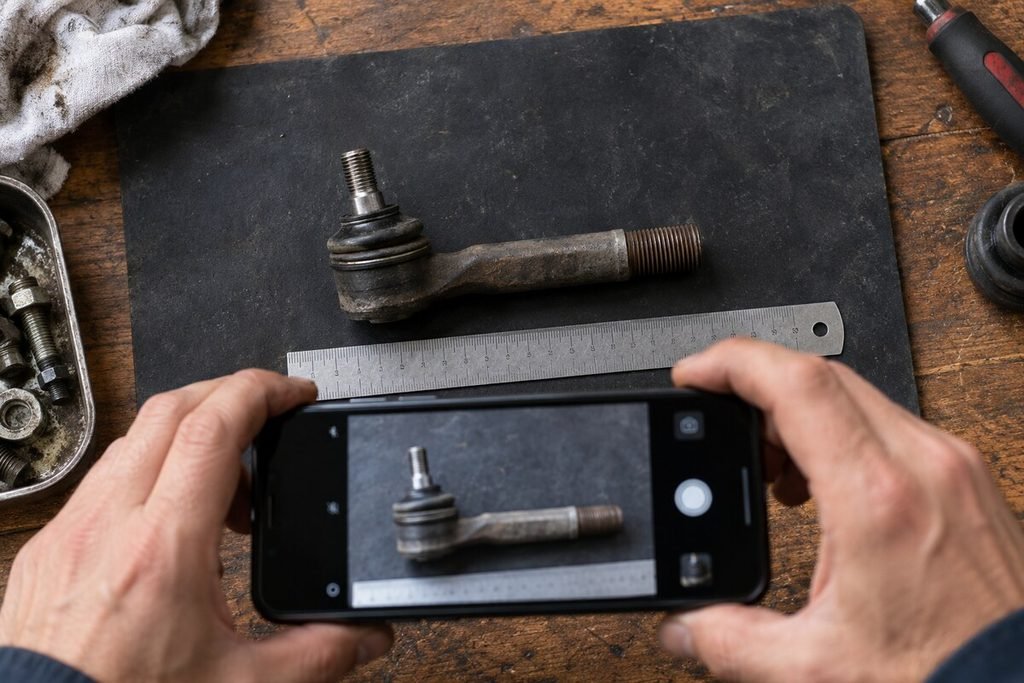
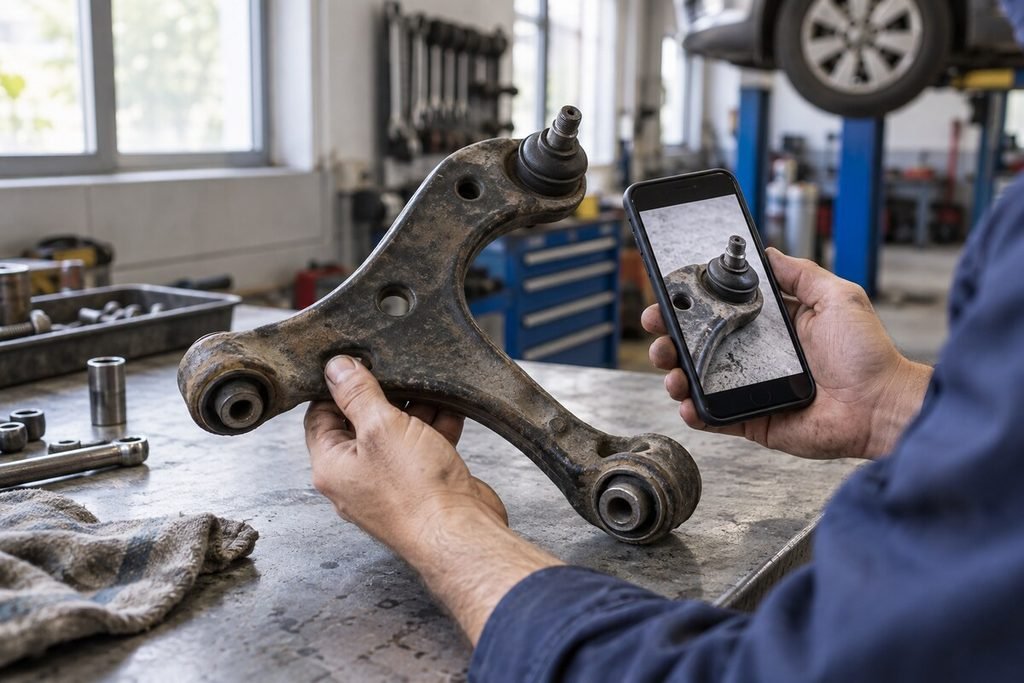
Take one clear photo of the complete part before moving in close. Put it on a clean bench or a plain floor, keep the camera level, and leave a little space around the edges. A full view helps the recipient understand the component family first: perhaps a control arm, tie rod end, ball joint or bracket.
Avoid sending a photo where the part is still hidden behind a wheel, hose or suspension arm. That image may explain the repair situation, but it rarely helps with a reliable identification. If the part cannot be removed, take a wider installed view and several close details.
Use four useful angles
For most chassis and steering parts, four angles give a much better starting point than one attractive close-up: front, back, each mounting end, and the most distinctive detail. Show bolt holes, bushes, threads, ball-joint studs, clips or electrical connectors where present.
Lighting matters more than phone model. Daylight near a workshop entrance usually works well. Wipe obvious oil from a stamped area and avoid direct flash on shiny metal; glare can hide the very characters that need checking. Hold the phone steady and focus on the feature, not the bench behind it.
Add scale without overclaiming
Place a ruler beside the part when possible. It gives the supplier a quick sense of overall length, hole spacing and thread size. Keep the ruler next to the component rather than across a marking or mounting point.
This is only a comparison aid. A ruler in a photo cannot replace formal measurement, a technical drawing or a catalogue check. Similar-looking parts can have different tapers, dimensions or mounting locations. Treat the image as evidence for narrowing options, not proof of the final part number.
Photograph markings separately
If there is an OE number, casting code or manufacturer mark, take one dedicated close-up. Clean the area gently and shoot it from more than one angle if the text is shallow. A single readable line may be more useful than five extra general photos.
When the mark is incomplete, say so. Do not invent missing digits from a similar listing. Include the vehicle make, model, production year, engine, chassis/VIN information and installation position where available. These details need independent verification before anyone confirms a quotation or a fitment.
Make left and right unambiguous
Left/right parts cause avoidable errors because “left” can mean different things in different markets. The safest approach is to provide an installed photo and state the viewing reference: driver side or passenger side, and whether the vehicle is left-hand or right-hand drive.
For front/rear components, an under-vehicle reference photo is equally helpful. One honest sentence such as “position not yet confirmed” is far better than a confident guess that reaches the wrong catalogue page.
Send a short evidence note
Before sending the images, add a short message: quantity required, vehicle information available, the part’s installed location, and whether a number is readable. This gives a supplier enough context to ask targeted follow-up questions instead of returning a generic “please send more details.”
Conclusion
Photo-based identification has real search demand, and image tools can be useful for a first pass. Yet a photo should begin verification, not finish it. For the next inquiry, use a full view, four detail angles, a scale reference, markings and an installed-position photo. Then confirm the OE number and vehicle application through reliable catalogue evidence before ordering.