
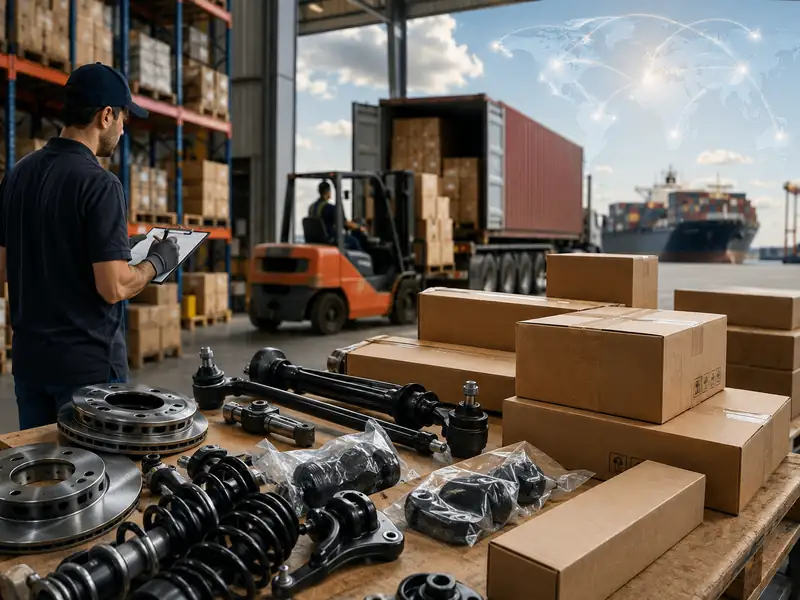
Buying auto parts for Middle East and Africa markets requires more than copying a catalog from another region. Climate, road quality, vehicle age, repair habits, and customer expectations all affect what sells and what survives.
These markets can be very attractive for importers, but they reward practical product choices. A part that sells well in a smooth-road urban market may not perform the same way under heat, dust, heavy loads, and long daily driving.
Durability should come first
In many parts of the Middle East and Africa, chassis and suspension parts face tough conditions. Heat, dust, rough roads, and overloaded vehicles put extra stress on control arms, stabilizer links, bushings, mounts, shock absorbers, and wheel bearings.
This does not mean every buyer needs the most expensive product. It means product quality must match the real conditions of use.
Vehicle age changes the product mix
Many markets have a large number of older vehicles and high-mileage cars. That usually creates strong demand for wear parts rather than rare specialty items.
Fast-moving products often include control arms, tie rod ends, ball joints, stabilizer links, engine mounts, suspension bushings, shock absorbers, and brake-related items. These parts solve regular repair needs and create repeat demand.
Fitment accuracy is critical
In busy repair markets, workshops do not want delays caused by wrong parts. Clean OE number mapping, clear application data, and useful product photos reduce mismatch risk.
If a market has many imported vehicle versions, fitment data becomes even more important. A buyer should not rely on model name alone.
Packaging needs to survive the journey
Long-distance shipping and multiple warehouse transfers can damage weak packaging. A carton may look fine at the factory but fail after stacking, unloading, and local distribution.
For heavy or sharp-edged parts, inner protection matters. Rubber boots, painted surfaces, and precision areas should not be exposed to rubbing or pressure.
Stable supply is part of the value
A slightly lower price is not useful if the supplier cannot support repeat orders. In fast-moving categories, stockouts can hurt customer trust.
Ask suppliers about lead time, repeat production, and whether they can support common SKUs consistently. A stable supplier is often worth more than the cheapest first quote.
Communication should be clear and fast
Buyers serving these markets often need quick confirmation. If a supplier takes too long to check OE numbers or cannot provide product photos, the business becomes harder.
A good supplier should answer clearly, confirm application details, and warn you when there is a fitment risk.
Start focused before expanding
New buyers should not try to cover every brand and model at once. Start with a clear list of common vehicles and high-frequency parts. Test product quality, packaging, communication, and claim handling before expanding.
Auto parts for Middle East and Africa markets need practical thinking. Focus on durable wear parts, clean fitment, strong packaging, and suppliers who can support repeat business. That approach gives importers a stronger foundation than a wide but unfocused catalog.
How to Source Auto Parts for Middle East and Africa
When sourcing auto parts for Middle East and Africa, buyers should confirm the destination market before comparing prices. Vehicle populations, road conditions and customer expectations can vary significantly between countries, so the same product range may not suit every market.
For each item, check the OE number, vehicle model, production year, engine information and installation position. If any detail is unclear, request a photo of the old part or the VIN or chassis number before confirming the quotation.
Buyers should also confirm stock availability, lead time, packaging, warranty terms and delivery arrangements. For a new supplier, a small trial order is usually safer than placing a large mixed order before product quality and communication have been tested.
Need help choosing the right product? Visit our product catalog or send us an inquiry.