
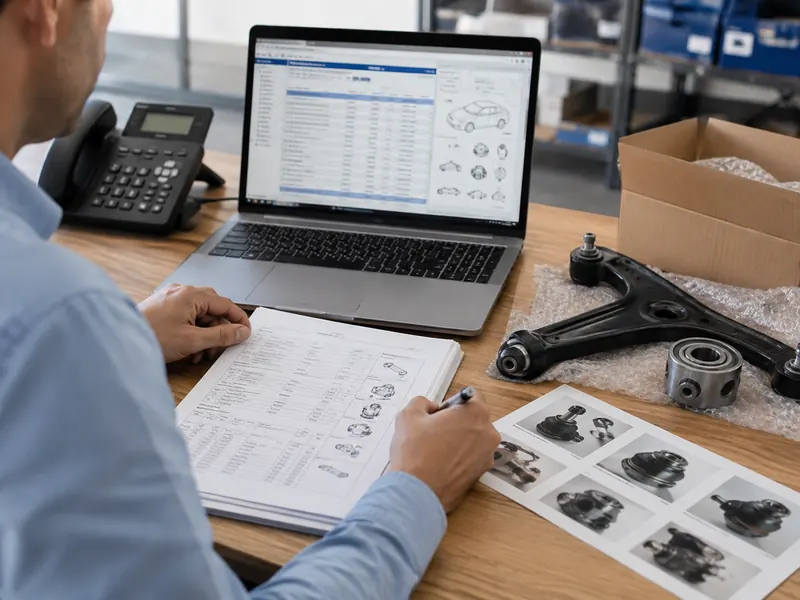

If you import or wholesale auto parts, learning how to check OE numbers is one of the simplest ways to avoid expensive mistakes. A single wrong digit, an outdated cross-reference, or a missing left/right position can turn a normal shipment into a long claim conversation.
Most buyers know OE numbers are important. The problem is that many teams still check them too quickly. A part may look similar, the supplier may say it fits, and the order moves forward. Then the goods arrive, the workshop starts fitting, and the trouble begins.
Why check OE numbers before placing an order
OE numbers are useful because they give both buyer and supplier a common reference. They are not magic, though. Some OE numbers are superseded. Some products share similar shapes but serve different chassis versions. Some catalog entries are simply incomplete.
That is why you should not rely on one number alone. A safer process is to match the OE number with vehicle information, product photos, and the final application.
Start with the cleanest source
Ask the customer for the exact OE number from the old part, service record, or original label. A photo is better than a typed message. In everyday trading, characters such as 0 and O, 1 and I, or a missing suffix create more confusion than people expect.
When possible, ask for the vehicle make, model, year, engine, and chassis code. If the customer can provide VIN information, even better. In chassis parts, the same model name can cover several versions. A control arm for one chassis may not fit another, even when both vehicles look almost the same from outside.
Compare more than one data source
Do not stop after one catalog match. Check the OE number against your own spreadsheet and the supplier’s catalog. If a cross-reference is provided, read the full application range instead of only checking whether the number appears.
If one source says the part fits W204 and another says W205, pause before confirming the order. That type of mismatch is exactly where wrong shipments begin.
Use photos to catch visible differences
Photos are not only for marketing. They help fitment checking. Ask for front and back photos, plus close-ups of the bushing, ball joint, bracket, mounting holes, connector, or sensor port when needed.
Small visual details often reveal a problem quickly. Hole count, arm curve, taper size, boot shape, and left/right orientation can be the difference between a correct part and a return.
Confirm whether the OE number is current
Some OE numbers have newer replacement numbers. Others refer to a complete assembly while a similar number refers only to the bare component. This matters for quoting, packaging, and customer expectation.
Before payment, put the final confirmed item into one clean line: product name, OE number, side or position, vehicle model, and quantity. For example: front lower control arm, OE 2113304311, left side, Mercedes-Benz W211, 50 pcs.
Keep your own verified fitment list
Every time a part is successfully verified and sold, save the result. Over time, your own verified data becomes more useful than random online catalog checks. It helps your team quote faster and reduces repeat mistakes.
A good OE number process is not complicated. Get the exact number, match it with the vehicle, compare more than one source, review photos, and confirm the final line item before ordering. That habit saves money, time, and customer trust.
What to Check Beyond the OE Number
An OE number is a strong starting point, but it should not be treated as the only fitment check. Before confirming an order, compare the vehicle model, production year, engine code, installation position and a clear photo of the old part.
Some OE numbers are replaced by newer references, while visually similar parts may use different connectors, dimensions or mounting points. If the buyer cannot provide a clear number, ask for the VIN or chassis number and complete vehicle details.
Record every confirmed reference in the quotation so the buyer and supplier are checking the same product before the order is placed.
For a complete request, use our auto parts inquiry template before asking for a quotation.
Need help choosing the right product? Visit our product catalog or send us an inquiry.