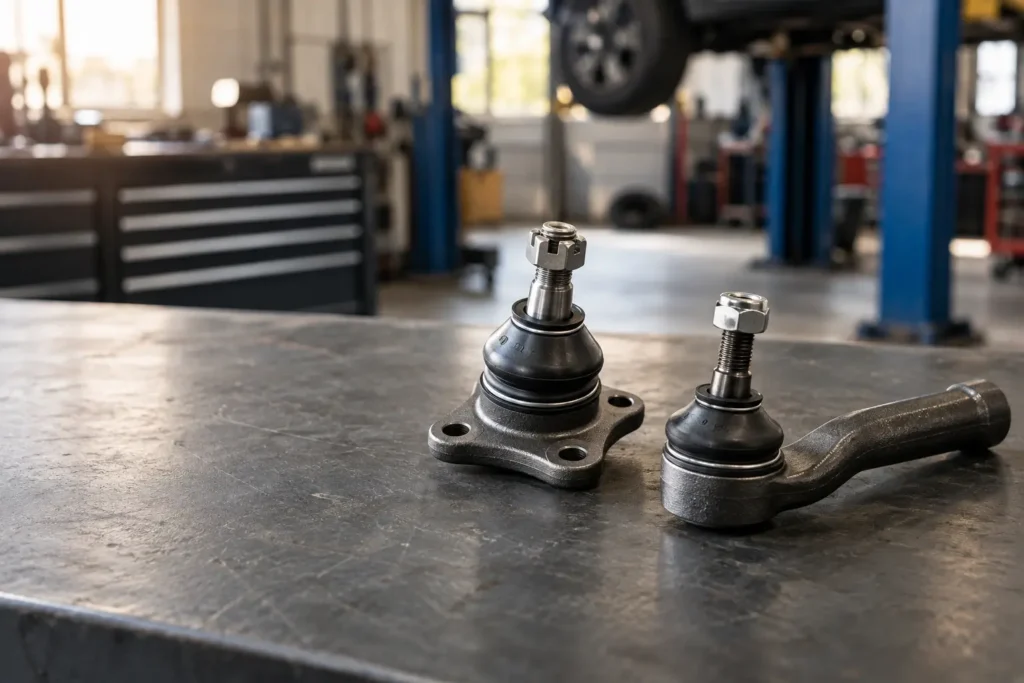
Ball joint vs tie rod end is a common comparison for buyers sourcing steering and suspension parts. Both use ball-and-socket joints and may look similar on some vehicles, but they serve different functions and should not be treated as interchangeable parts.. They are often discussed in the same conversation, and on some vehicles they may look broadly similar. But they do not perform the same job, and ordering one by appearance is a costly shortcut.
A ball joint normally connects suspension components and allows controlled movement as the wheel travels. A tie rod end is part of the steering linkage: it transfers steering movement from the rack or centre link to the steering knuckle. Both are safety-related parts, so the application and connection details need to be checked carefully before an order is confirmed.
Ball joints and tie rod ends can look similar, but their fitting details are not interchangeable.
Ball joint: suspension movement and wheel control
A ball joint is commonly used between a control arm and the steering knuckle, or integrated into a control arm assembly. It allows the suspension to move while keeping the wheel located in the intended geometry.
Depending on the vehicle design, a ball joint may be upper or lower, left or right, press-fit, bolt-on, screw-in or supplied as part of a complete control arm. These are not small differences. They decide whether the part can be installed at all.
Tie rod end: steering input to the wheel
The outer tie rod end connects the steering linkage to the steering knuckle. When the driver turns the steering wheel, the steering system moves the tie rod and the tie rod end helps turn the wheel.
For tie rod ends, the thread direction, thread size, taper, overall length and left/right application are often critical. Some vehicles also use an inner tie rod and an outer tie rod end as separate components. A buyer should make clear which item is required.
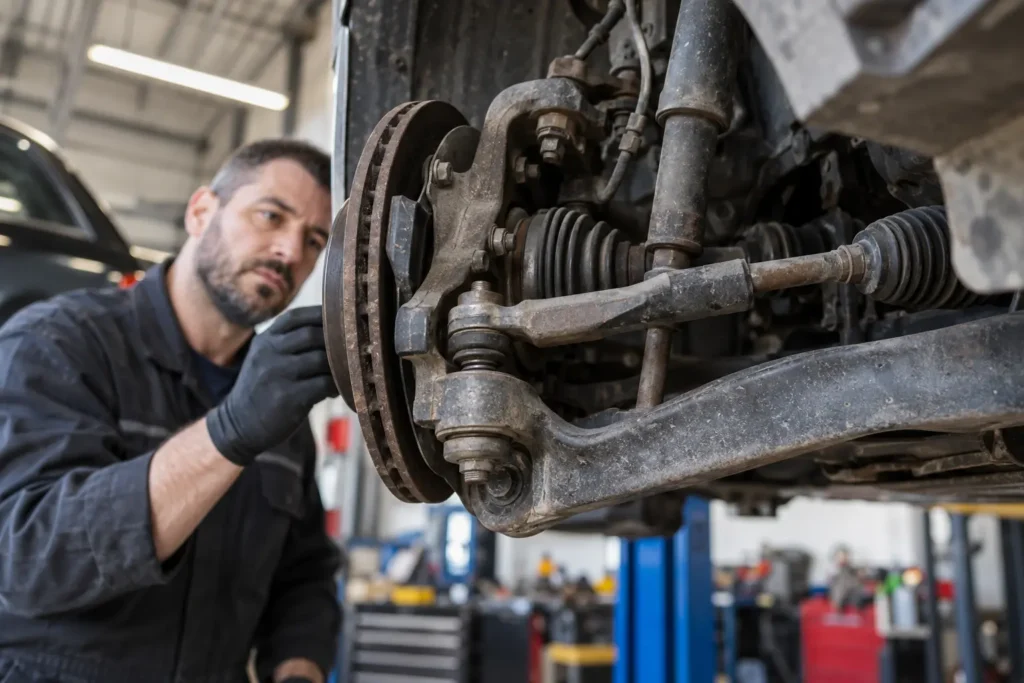
Suspension and steering components meet around the wheel assembly, so fitting details matter.
Why photos alone are not enough
A clear photo is valuable, especially if it shows the mounting face, pin, thread and any markings. Yet a photo should support the identification process, not replace it. Similar-looking parts can have different taper angles, thread sizes, lengths, boot shapes or bolt spacing.
For this reason, the best approach is to use an OE number or a reliable catalogue reference first, then use the photo to check the physical version. If the OE number is not available, ask for the vehicle VIN, model, year, installation position and dimensions before giving a final fitment confirmation.
Six details to confirm before quoting
- Part type: ball joint, outer tie rod end, inner tie rod, or complete control arm.
- OE number or catalogue reference: do not rely on a general product name.
- Installation position: left/right, front/rear, upper/lower.
- Mounting method: press-fit, bolt-on, screw-in or integrated into an assembly.
- Key measurements: taper, thread, pin length, housing diameter or centre-to-centre distance when applicable.
- Quality expectation: standard aftermarket, premium aftermarket, or a specific material/boot requirement.
Common buying mistakes
Ordering “one tie rod end” without side information. Many steering applications differ left to right. A supplier needs the OE reference or a confirmed application to avoid a mirror-image error.
Assuming a control arm always includes the ball joint. Some control arms are supplied complete; others require the ball joint separately. The quotation should state exactly what is included.
Comparing only the lowest price. A cheaper component may be made to a different specification. Ask about the included hardware, boot material, finish, warranty terms and packaging level before deciding that two offers are equivalent.
What to put in your enquiry
Please quote for the following item: [ball joint / outer tie rod end]. OE number: [number]. Vehicle: [model, year, engine if known]. Position: [left/right, front/rear, upper/lower]. Quantity: [quantity]. Please confirm product photo, packing, available quality option and lead time.
Buy with the application, not just the shape
Ball joints and tie rod ends are simple-looking parts with very specific fitment requirements. A short but complete enquiry gives a supplier enough information to verify the correct item and gives the buyer a better basis for comparing offers.
For related sourcing advice, read why suspension parts fail early and our guide on reducing auto parts returns before shipping.
JASPEEDA supports OE-number based enquiries for selected steering and suspension parts. Send your reference, vehicle details and quantity, and we will check the available options before quotation.
What is the main difference between a ball joint and a tie rod end?
A ball joint connects suspension components and allows controlled movement as the wheel travels. A tie rod end is part of the steering linkage and transfers steering movement to the steering knuckle.
Can I identify a ball joint or tie rod end by appearance alone?
Not reliably. Buyers should check the OE number, vehicle application, installation position and product details before ordering.
What information should I provide when requesting a quotation?
Send the OE number, vehicle model, year if available, required quantity and a product photo when possible.
Need Help Checking a Ball Joint or Tie Rod End?
If you are not sure which part matches your vehicle, send us the OE number, vehicle model, product photo and required quantity. JASPEEDA can help check the reference information before quotation.