
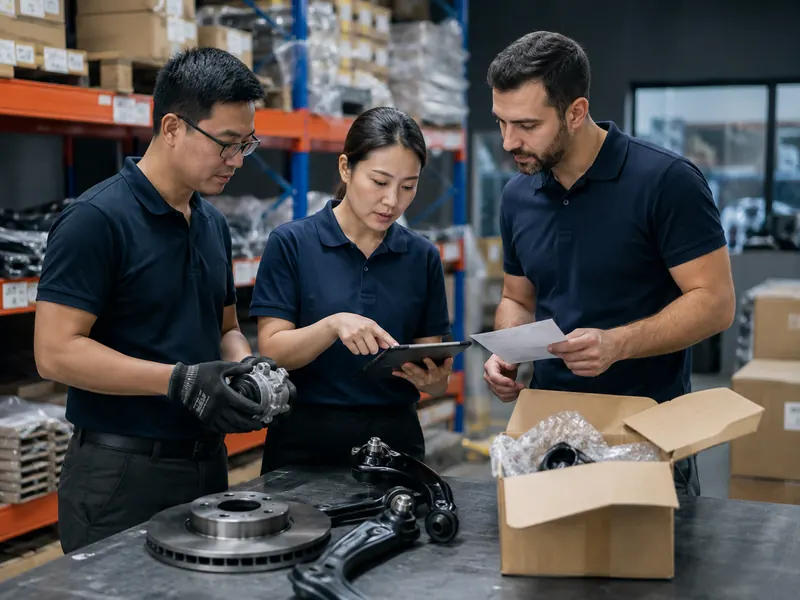
A control arm supplier checklist helps importers look beyond the first price. In real business, the best supplier is not always the one with the lowest quotation. It is the one that helps you sell with fewer returns, fewer complaints, and fewer surprises after the shipment arrives.
Many buying decisions are still made too quickly. A sample looks fine, the price looks attractive, and the order is placed. A few months later, claims begin. The saving disappears.

Product consistency comes first
One clean sample does not prove batch quality. Ask how the supplier controls consistency across repeated orders. Are bushings sourced from the same standard? Are ball joints assembled and tested in the same way? Is the finish stable from batch to batch?
A reliable supplier should explain this without confusion. If every answer is vague, take that seriously.
Check material and rubber quality
Control arms work under load, vibration, heat, water, and road impact. Poor steel, weak aluminum casting, unstable rubber, or bad bonding can shorten service life quickly.
Ask what material is used. Ask whether the supplier can share basic specifications. For rubber parts, ask about hardness, bonding, and aging performance. You do not need a long technical lecture. You need proof that the factory understands what affects the part in real use.
Fitment control is not optional
A supplier should not only say, “It matches the OE.” Ask how the match is confirmed. Do they use OE samples? Do they measure key mounting points? Do they compare taper, thread, arm geometry, and bushing position?
Fitment problems often start from small differences. A serious control arm supplier should have a clear process for checking dimensions before production and before shipment.
Ask about testing, but keep it practical
You do not need every report for every order. Still, the supplier should be able to provide relevant testing information when needed. Useful checks may include fatigue testing, hardness, salt spray, tensile strength, and ball joint durability.
The point is not to collect paperwork for decoration. The point is to know whether the supplier can support the product quality you plan to sell.
Packaging affects claims
Packaging is often discussed too late. If the ball joint boot is compressed, the painted surface gets scratched, or the box is too weak, the part can arrive in poor condition even if it was made correctly.
Ask for photos of inner packing, labels, and outer cartons. For export orders, carton strength and part separation matter a lot.
Communication is part of quality
Good communication reduces mistakes. A supplier who flags application risks, sends clear photos, and asks follow-up questions is usually safer than one who replies “no problem” to everything.
When you send an OE number, the supplier should check the application and confirm any uncertainty. That is a sign of a real partner, not just a seller.
Run a small test order
Before placing a large order, run a smaller sample or mixed SKU order. Check appearance, fitment data, packaging, labels, and communication speed. If possible, ask a workshop partner to review the product.
A strong control arm supplier gives you stable product quality, honest technical support, clear data, workable packaging, and predictable communication. That combination builds better business than a cheap first order.
Questions to Ask Before a Bulk Control Arm Order
Before confirming a bulk control arm order, ask the supplier for more than a price list. Confirm the OE number, vehicle application, left or right position, and whether the item is supplied with bushings or a ball joint where applicable. These details help prevent buyers from comparing different versions of the same-looking part.
It is also useful to ask how the control arm is made, what quality checks are used for the bushing and ball joint, and how the parts are protected during transport. A supplier should be able to provide clear photos, packing details and a realistic delivery schedule.
For a first order, start with a small quantity or sample where possible. Check the part against the agreed OE reference and vehicle application before placing a larger order. This simple step can reduce fitment mistakes, return claims and unnecessary delays later.
Need help choosing the right product? Visit our product catalog or send us an inquiry.